
Tabletop field guide · 50 challenges
Say Cheese Logic Puzzle: Rules and How to Play
The complete one-player rolling puzzle: what is in the box, how a move changes a mouse, how the move limit works, and what the player demonstrations add to the printed rules.
Quick answer
This is a one-player, 50-challenge rolling puzzle. Choose a challenge, arrange the cheese blocks with every mouse tails-up, then roll blocks into adjacent spaces until every mouse is snout-up within the listed move count.
Project Genius and Eureka sell editions of the same described game. The US and European product pages agree on the one-player, 50-challenge mechanic, but do not state an exact licensing or component-identity relationship.
Sources checked 2 November 2026. The publisher pages do not list the exact block count or board dimensions. Those details are marked as player demonstrations where used.
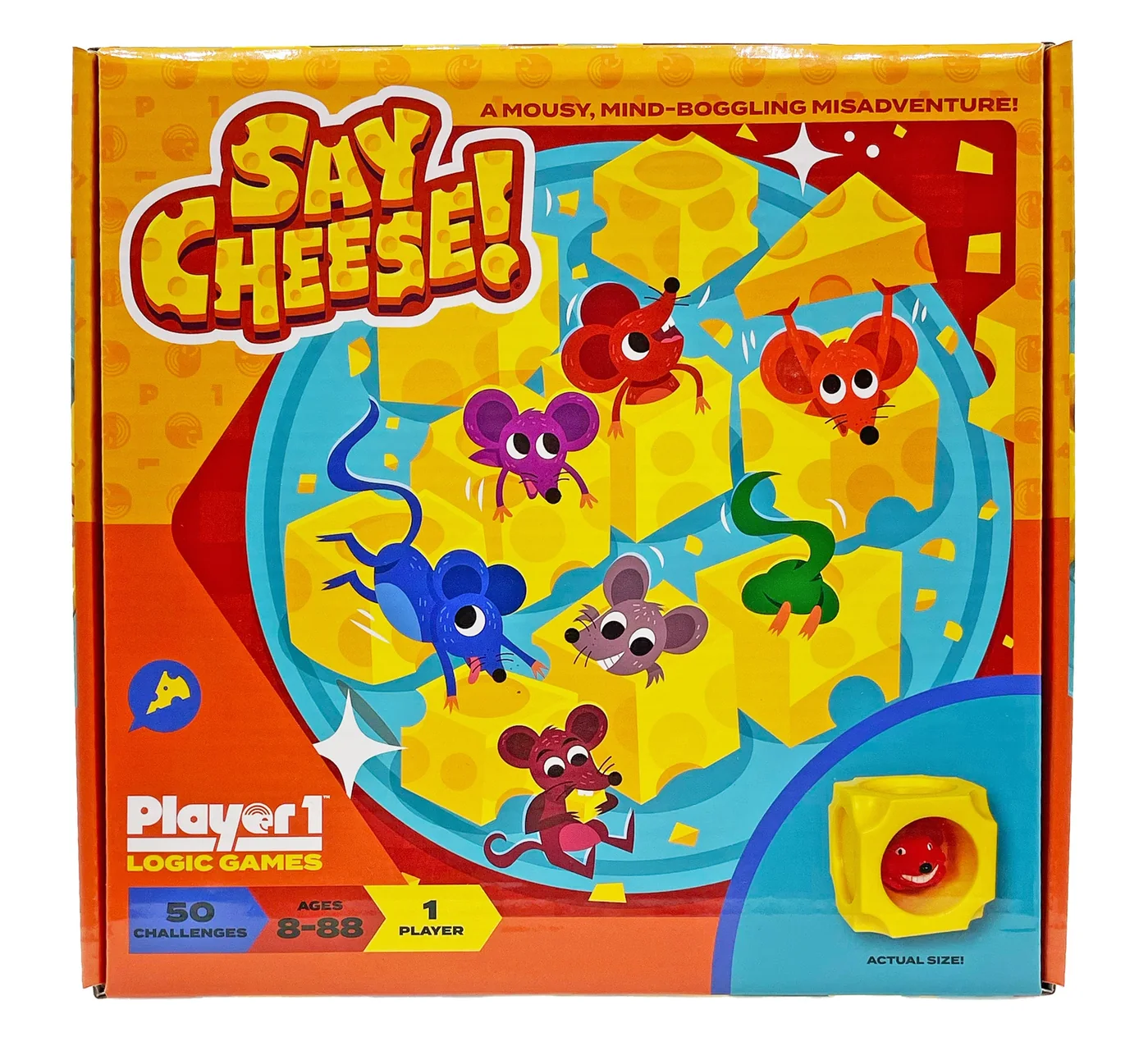
The physical rolling puzzle, not the digital games
This page covers the physical Say Cheese logic puzzle sold by Project Genius in the US and Eureka as Ah!Ha Say Cheese in Europe. It is a one-player rolling puzzle with 50 challenges. It is not the Roblox story, the Gamewright Quick Pics dice game, or the 40-level mouse maze sold on Steam and console stores.
It is also not the Logic Roots Say Cheese multiplication game. That is a 2–4 player math game. The search results mix the two because the names and mouse theme overlap.
What is in the box
| Edition | Identity | Price | Notes |
|---|---|---|---|
| Project Genius | Say Cheese · Player 1 Logic Games | $19.99 USD | 1 player · age 8+ · 50 puzzles · 1, one-player logic game |
| Eureka | Ah!Ha Say Cheese · article 473546 · EAN 5425004735461 | €19.95 | 1 player · 50 challenges · levels 1–4 · box about 22 × 22 × 5 cm · instructions in English, French, German and Dutch |
Scroll the table sideways if it is wider than your screen.
The two publishers describe the same one-player, 50-challenge cheese-rolling mechanic. Their exact licensing relationship and component checklist are not stated on the pages checked.
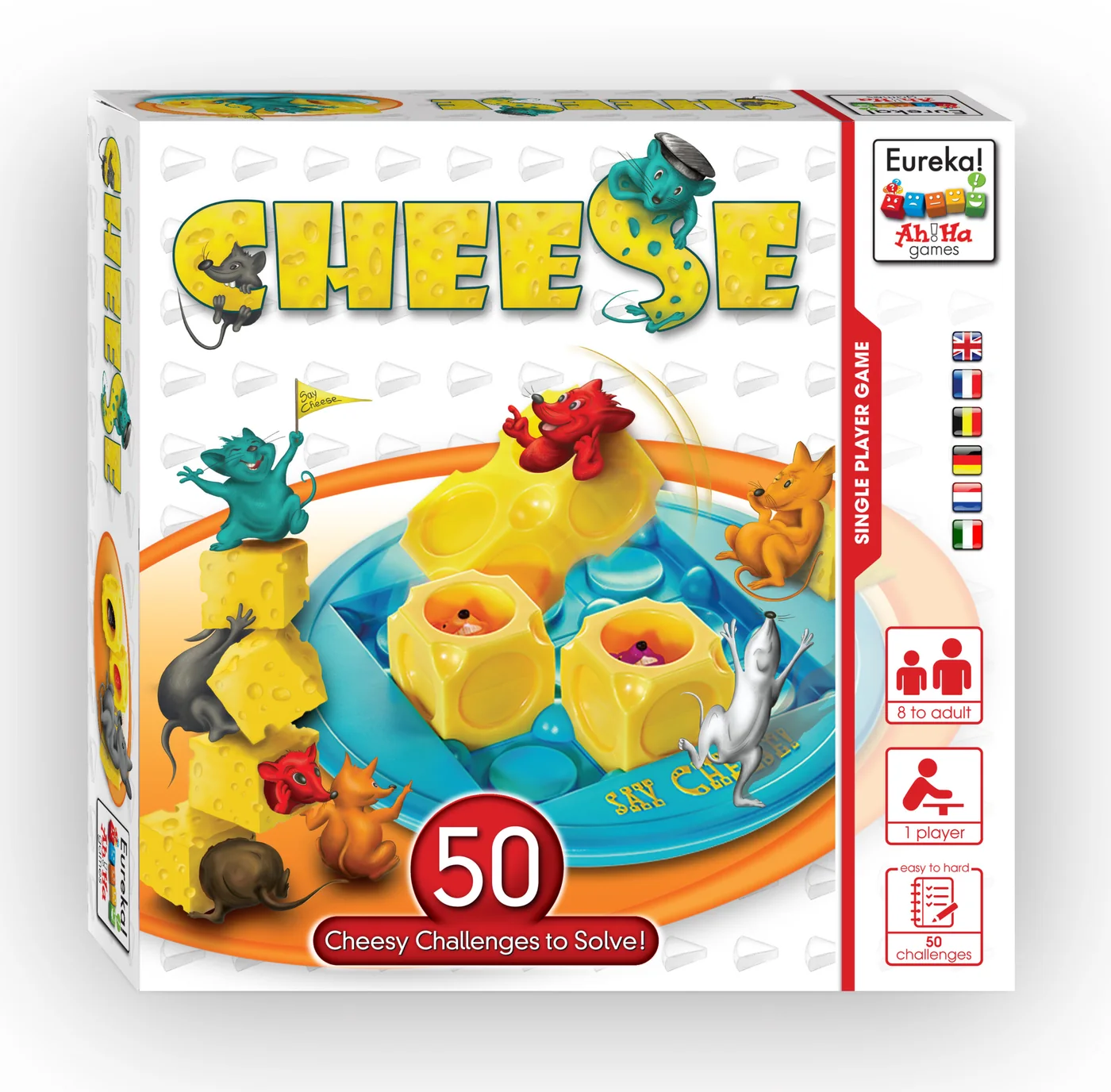
The printed challenge book is part of the box. The exact number of loose cheese blocks is not stated on either product page. A demonstration video shows later challenges using four or five blocks, with different-sized pieces, so do not assume the box contains a fixed set of five identical cubes.
Set up a challenge
- Choose a challenge from the booklet. The later challenges use more blocks and different board configurations.
- Arrange the cheese blocks to match the challenge picture.
- Check that every mouse starts tails-up (its back or butt facing you), not already face-up.
- Confirm the move limit printed with the challenge. The limit is part of the puzzle, not a suggested time.
- Start with the first legal roll and count each roll as one move.
How one move works
The publisher’s instruction is short: move the blocks by rolling into any adjacent space. A move is one block rolling from its square into a neighboring square. The cube turns over as it rolls, so the face pointing upward changes. That is how a mouse can move from tails-up to face-up without leaving the board.
- One block, one square. Do not push a stack or slide a block through multiple spaces in one move.
- Empty landing space. The target square must be available. A block already occupying it stops the roll.
- Face check after the roll. Look at the mouse on the new top face. The goal is about the top face, not the block’s position alone.
- Edge warning. A player demonstration warns that turning a mouse’s back to the board edge can make the face difficult or impossible to turn up in the remaining moves. Treat that as practical advice, not a printed rule.
The win condition and the move limit
The run succeeds when every mouse is face-up (snout-up) within the challenge’s listed move count. Position alone is not enough. If you use all the moves and any mouse is still tails-up, the challenge is not solved; return to the starting arrangement and try a different sequence.
- Finish a roll and check the full board.
- If any mouse is still tails-up, keep rolling while legal moves and moves remain.
- If the move count runs out or the board reaches a dead end, reset the pictured starting arrangement.
- If you need a solution, use the answer section in the challenge booklet or the publisher’s product-solution lookup for that edition.
Do not count a move that only repositions a correctly oriented mouse away from its final square as progress. Late challenges often require planning several rolls ahead, especially when the center mouse or a larger block limits the available landing spaces.
The 50 challenges and their difficulty
Both editions list 50 challenges from easy to hard. The Eureka product page labels four levels, 1 through 4. The exact challenge numbering and the number of blocks used per challenge can differ between editions, so use the booklet that came in your box rather than borrowing a sequence from another copy.
A player demonstration describes a 3 × 3 play field. The publisher pages do not state the board dimensions, so treat 3 × 3 as a demonstration detail. The same video shows early challenges with one to three blocks and later challenges with four or five, including larger and smaller pieces. Those counts are examples from the demonstrated copy, not a complete component list.
Player-tested tactics worth trying
These are observations from a recorded play session, not publisher instructions. They are useful starting points when a challenge stalls.
- Give the center mouse room. The player demonstration estimates that a centrally placed mouse needs at least five rolls to finish face-up. Start that block early instead of leaving it for the last move.
- Keep the butt away from the edge. A mouse whose back faces the outer boundary can be difficult to turn over because the needed roll direction is blocked. Leave a return square on the inside.
- Keep a lane open. Late puzzles use several blocks; a block that looks solved can block the only landing space another mouse needs. Plan the last three rolls before you make the first one.
- Reset earlier. Once two orientations are wrong and the move count is nearly gone, a clean restart is faster than improvising rolls that cannot finish every mouse.
Edition and availability notes
The US Project Genius page listed $19.99 at the time of research. Eureka listed €19.95 with article 473546. A third-party Learning Post listing showed a higher $23.99 price and Sold Out status; that is a retailer snapshot, not a publisher-wide availability statement.
Check the edition named on your box before buying a replacement or looking up a solution. The Project Genius and Eureka pages describe the same one-player, 50-challenge mechanic, but neither page states that every component, printing, or retail relationship is identical.
Common questions
01How many people can play the Say Cheese logic puzzle?
One. Project Genius lists it as a single-player game for ages 8 and up; the box shown in the source material also prints 8–88. It is a solo challenge, not a two-player race.
02Are there 50 challenges, and do they get harder?
Yes. Both retail pages describe 50 challenges, and Eureka labels four difficulty levels from easy to hard. The exact block configuration changes between challenges; the product pages do not list a universal number of blocks per challenge.
03Is the board 3 × 3?
A recorded player demonstration describes a 3 × 3 play field. The Project Genius and Eureka product pages checked do not state the board dimensions, so 3 × 3 is a demonstration detail rather than a publisher specification.
04Are the Project Genius and Eureka versions identical?
The pages describe the same one-player, 50-challenge mechanic and goal, but they do not state an exact licensing or component-identity relationship. Treat them as two retail editions of the described puzzle and use the booklet from your copy.
05Is this the same as the Logic Roots Say Cheese game?
No. Logic Roots sells a 2–4 player multiplication game under the same name. This page covers the one-player cheese-rolling puzzle from Project Genius and Eureka.
06Where can I find a solution if I am stuck?
Use the answer section in the challenge booklet that came with your edition, or the Eureka product-solution lookup if your edition supports it. The Eureka lookup may require the full barcode from the original box.
Sources and limits
Sources & methodChecked 2 November 2026
These sources support the rules, routes, platform notes and version limits on this page. This site is an independent guide and has not reproduced every claim in-game.
- Official storeProject Genius — Say Cheese US edition, one-player goal, 50 puzzles, rolling rule and $19.99 price.
- Official storeEureka — Ah!Ha Say Cheese Article 473546, EAN, 50 challenges, four levels, €19.95, instruction languages, box size and solution lookup.
- RetailerLearning Post & Toys — Say Cheese Supporting price and availability snapshot; not a publisher stock statement.
- Different productLogic Roots — Say Cheese multiplication game Used only to separate the 2–4 player multiplication game from this puzzle.
- VideoCUBASTIC — Say Cheese puzzle demonstration 16 May 2023; player-described 3×3 field, edge advice, center estimate, later block counts and answer-key note.